The Apply Universe Restrictors feature creates a subset of the dataset for download using the variables listed in the Selected Variables tab. It may also be used when creating a Frequency / Table.
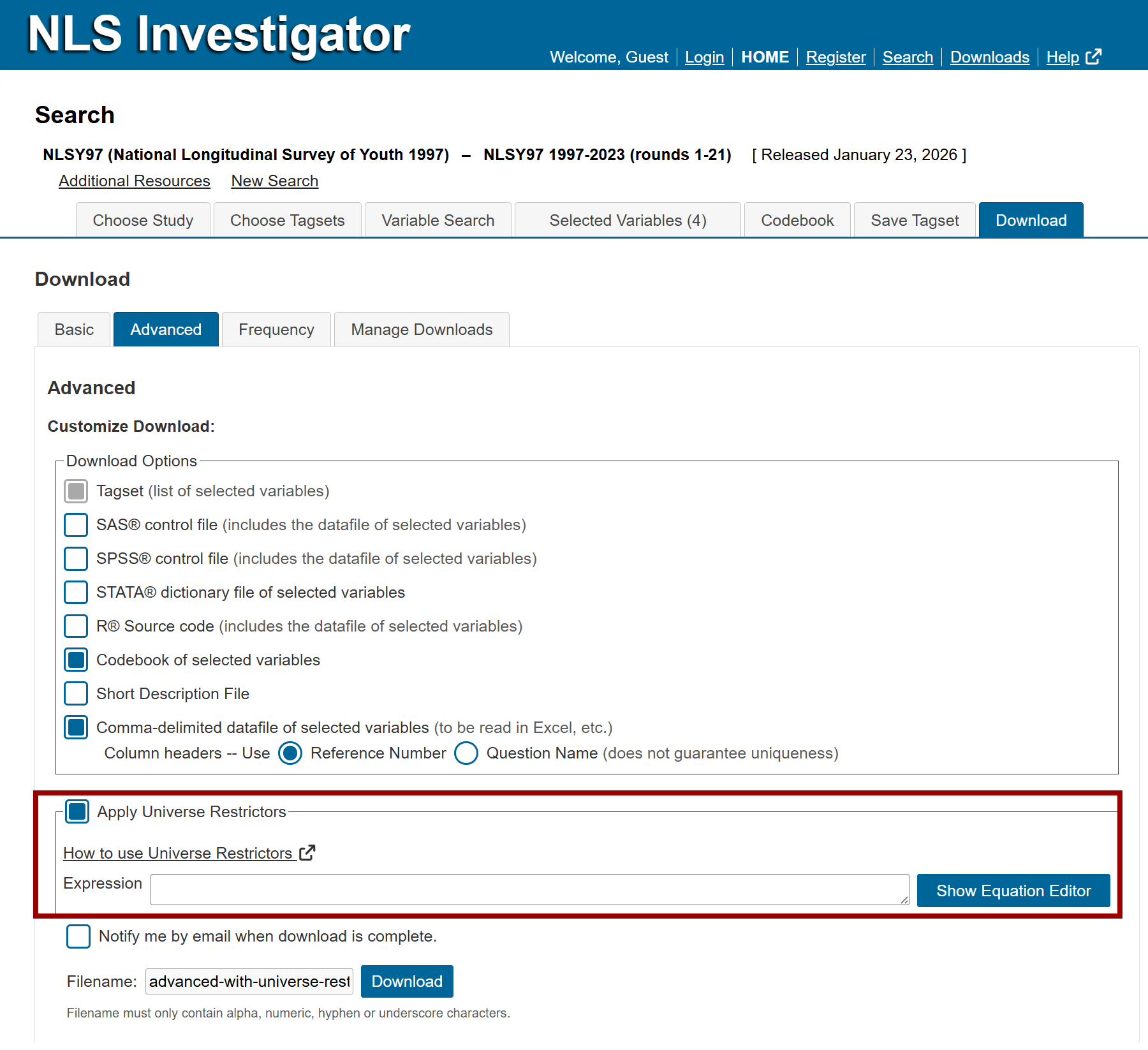
To create a universe restrictor, select the Apply Universe Restrictors checkbox when generating a data download or frequency table. An Expression field appears, along with a Show Equation Editor button. You can either enter an expression directly in the field or use the Equation Editor to build one.
All variables referenced in the examples below are already available in the Selected Variables tab, except for the Highest Grade Completed (HGC) variable. To follow along, add the HGC variable to your tagset by navigating to the Variable Search tab and entering the following search criteria:
- Search Types = Reference Number (enter search term)
- Operators = starts with
- Values = Z9083800
Using the Equation Editor
The Equation Editor creates expressions that restrict the data universe based on one or more conditions.
Equation Editor components
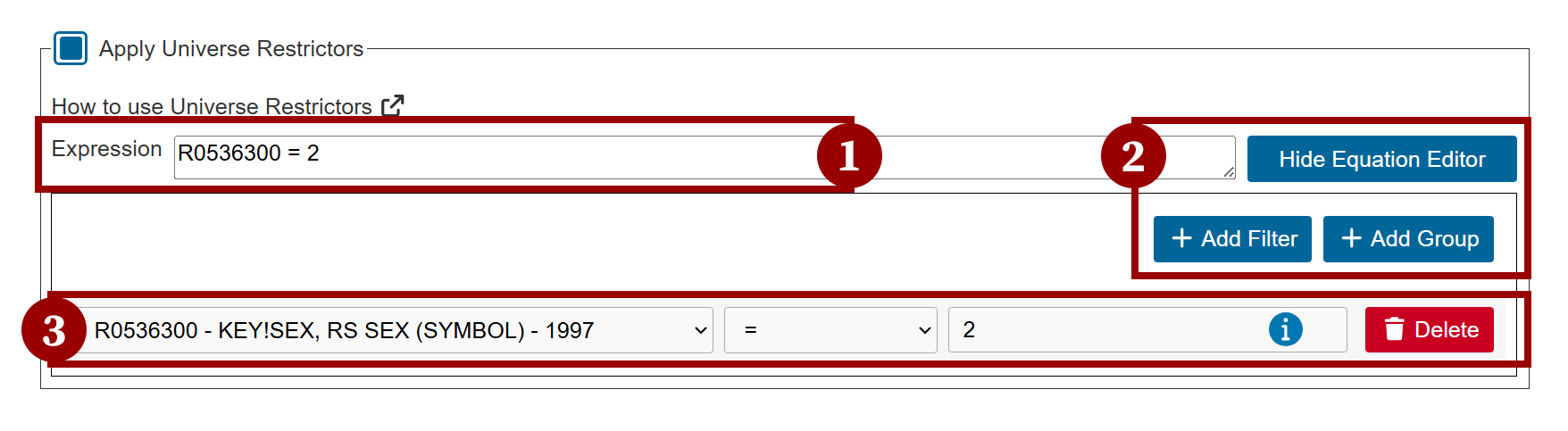
The image below highlights three main areas of the Equation Editor:
- Expression field: Displays the complete expression used to restrict the data universe.
- Action buttons:
- Hide Equation Editor
- Add Filter
- Add Group
- Equation builder fields: Used to create individual equations, along with a Delete button to remove filter selections.
Creating an equation
To build an equation, complete the fields from left to right.
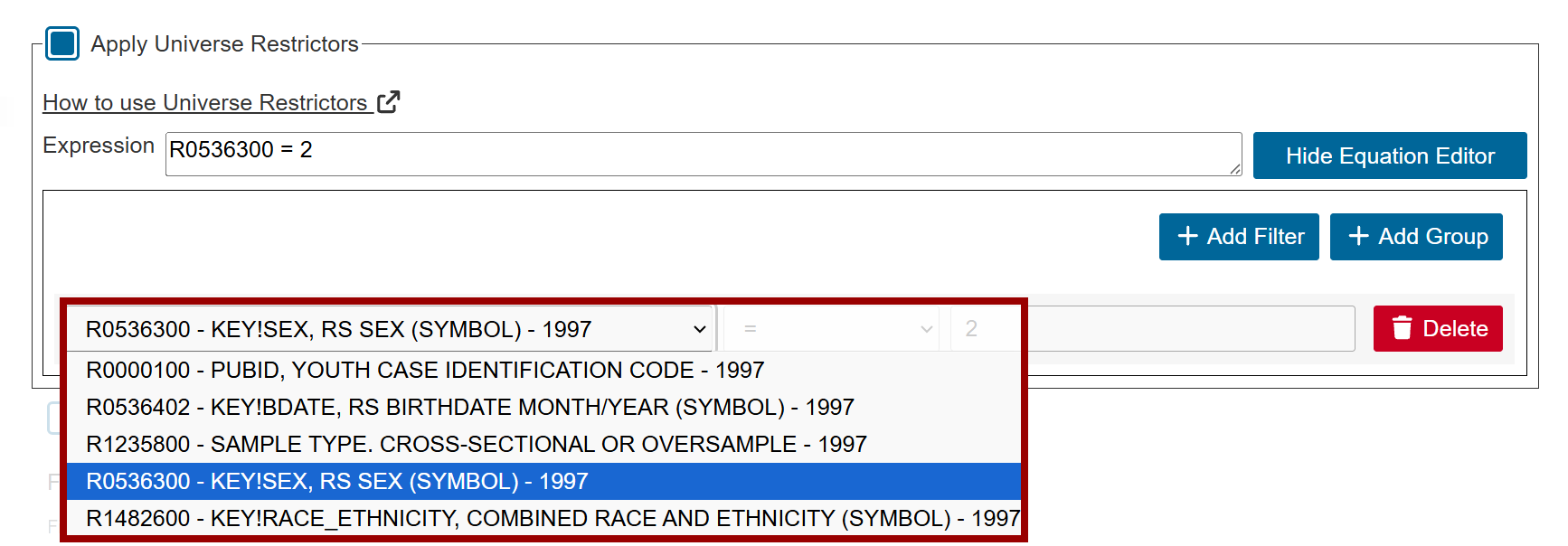
Step 1: Select a variable
Use the first drop-down menu to select a variable from those listed on the Selected Variables tab.
Step 2: Select an operator
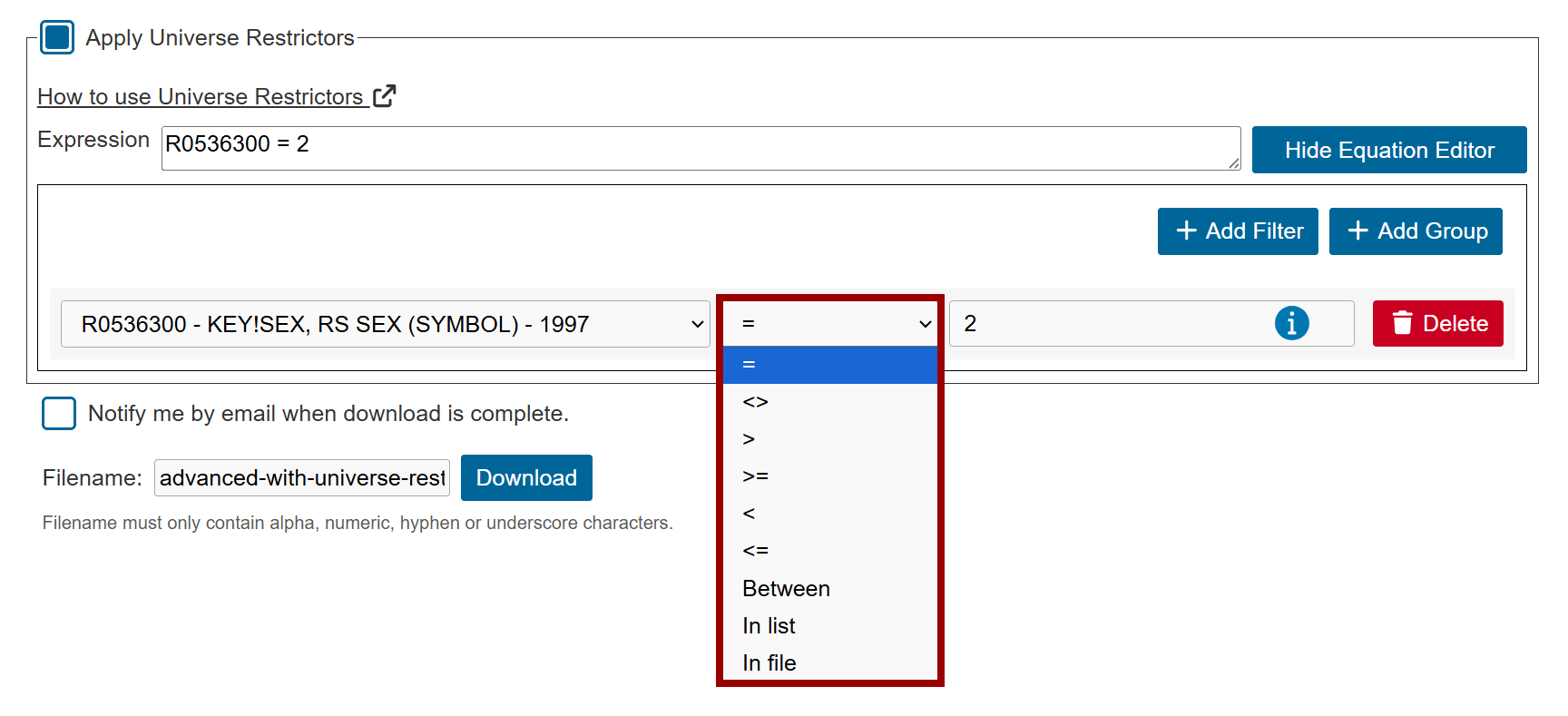
Use the second drop-down menu to choose an operator that defines the relationship between the variable and the value(s) entered.
Available operators include:
- Equal to =
- Not equal to <>
- Greater than >
- Greater than or equal to >=
- Less than <
- Less than or equal to <=
- Between -Enter two values to define a range
- In list -Enter a comma-separated list of values (for example: 1, 9, 17, 33, 58, 72, 100)
- In file -Upload a file containing a list of values
Step 3: Enter a value
Enter the value or values needed to complete the equation.
The up and down arrows next to the information icon can be used to cycle through valid values. You can also consult the variable's codebook to identify valid values and ranges.
Example: Creating a single filter
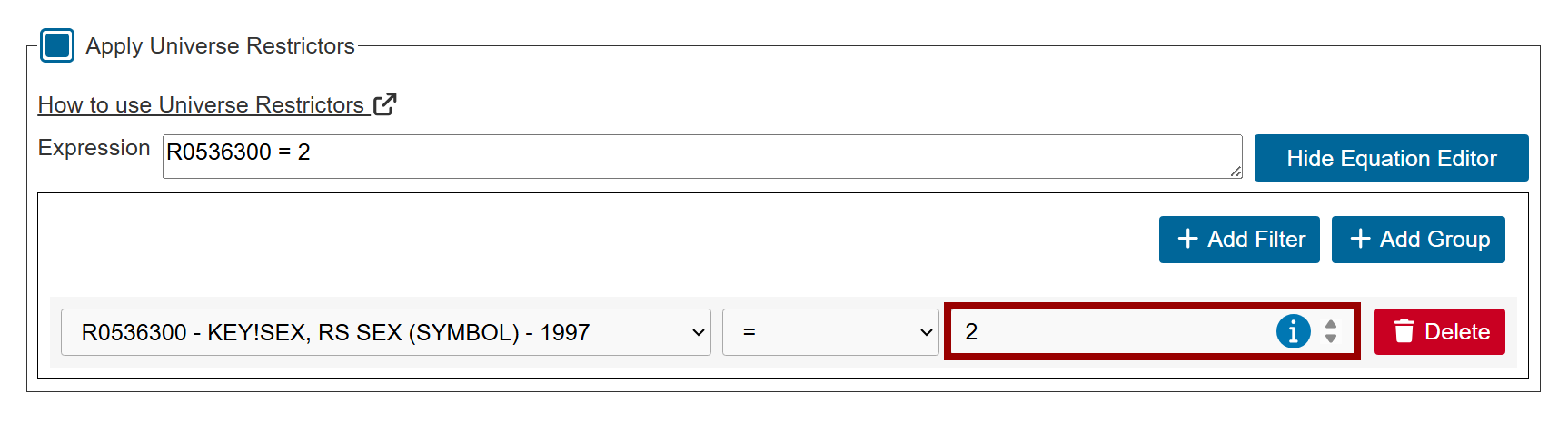
In the example below, the expression contains a single equation:
- R0536300 = 2
This equation limits the dataset to female respondents when the selected variables are downloaded.
Adding multiple filters
You can add additional equations to create more complex universe restrictors.
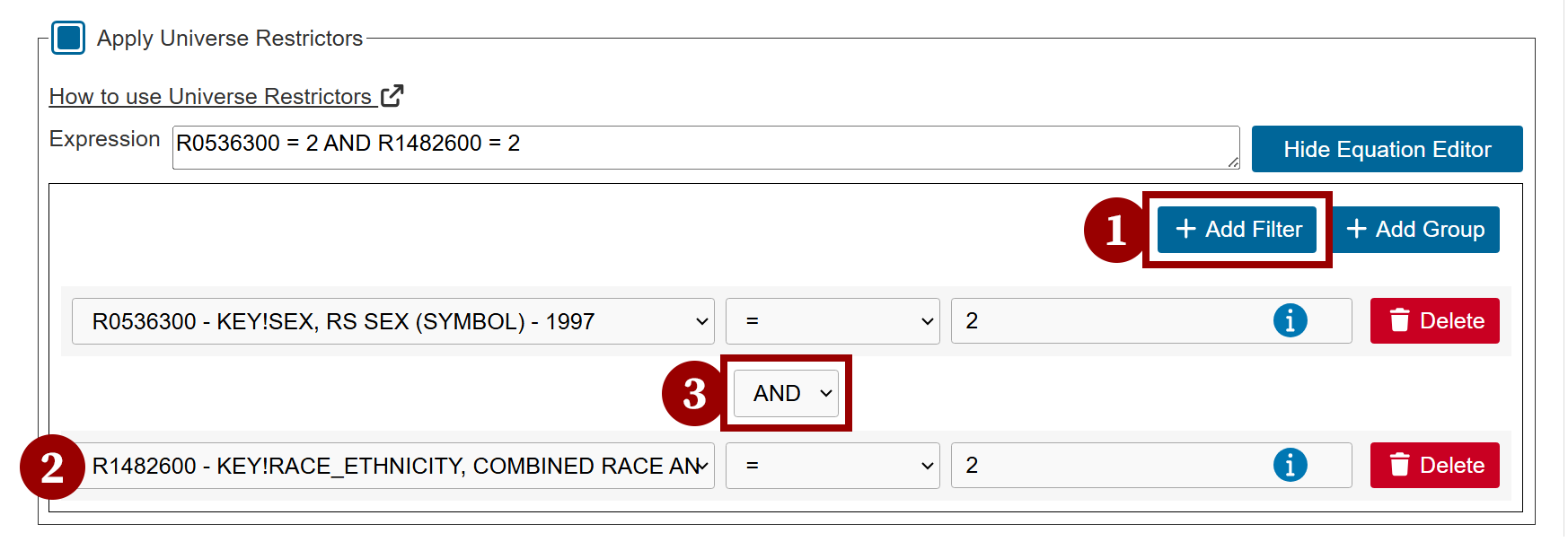
Step 1: Add another filter
Click Add Filter to add a new set of equation fields.
Step 2: Create the additional equation
Construct the new equation using the same process described above.
Step 3: Choose a logical operator
Select the operator that will connect the equations in the expression:
- AND
- OR
Understanding AND vs. OR
The operator you choose determines how multiple conditions are applied.
Using AND
The following expression:
- R0536300 = 2 AND R1482600 = 2
returns only respondents who meet both conditions:
- Female (R0536300 = 2)
- Hispanic (R1482600 = 2)
The resulting dataset includes only Hispanic female respondents.
Using OR
The following expression:
- R0536300 = 2 OR R1482600 = 2
returns respondents who meet either condition.
The resulting dataset includes:
- All female respondents, regardless of race/ethnicity, and
- All Hispanic respondents, regardless of sex.
Because respondents only need to meet one condition, this dataset may include both Hispanic males and females, as well as non-Hispanic females.
Using parentheses and groups in expressions
For complex expressions, you can control the order in which conditions are evaluated by:
- Typing parentheses directly into the Expression field, or
- Using the Add Group button, which automatically places related conditions inside parentheses.
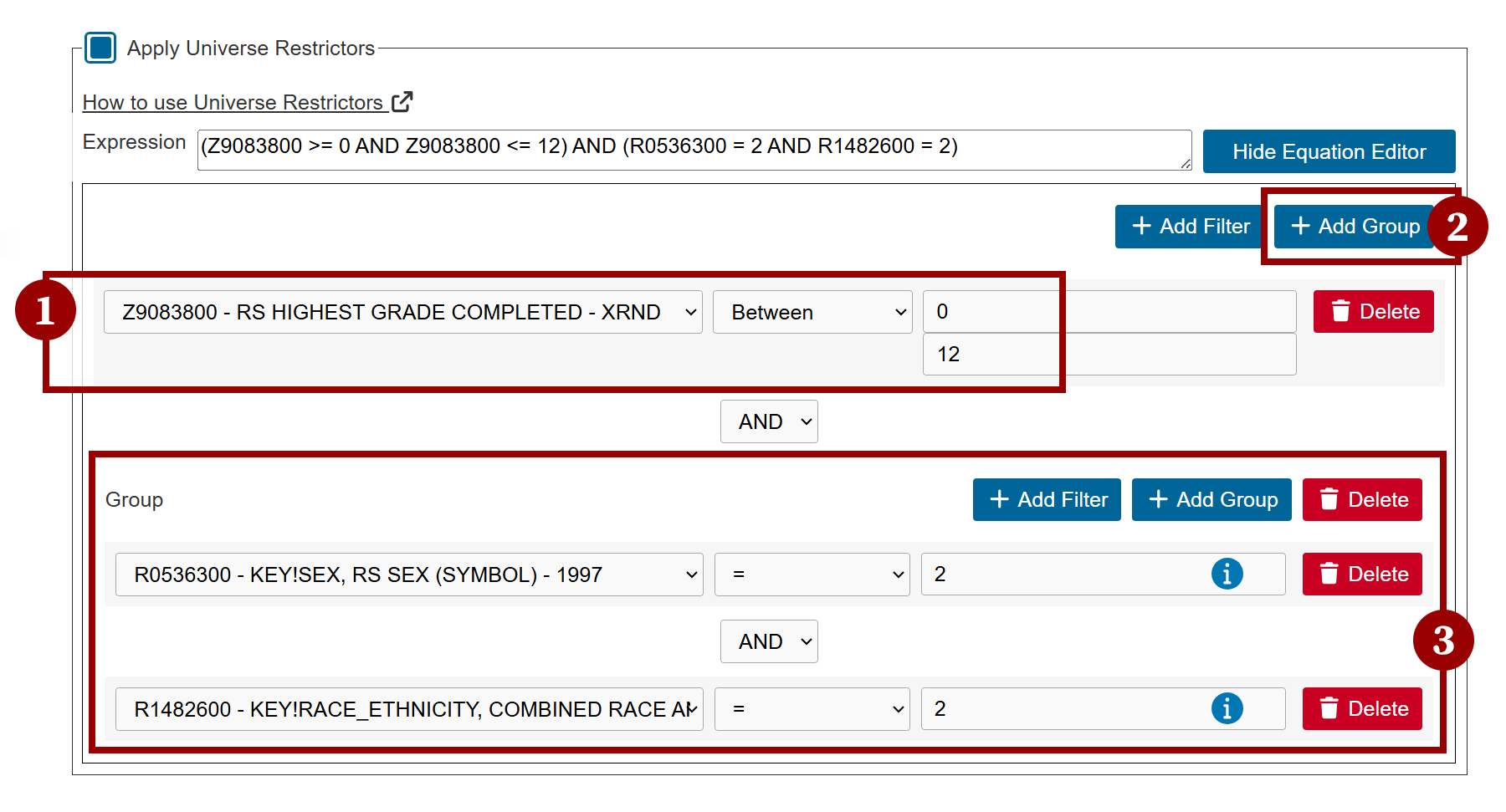
In the next example, the goal is to create a subset containing only Hispanic female respondents whose highest grade completed is 12th grade or lower. Following the steps below will build the final expression:
- (Z9083800 >= 0 AND Z9083800 <= 12) AND (R0536300 = 2 AND R1482600 = 2)
Step 1: Filter by Highest Grade Completed
The first set of conditions uses the Highest Grade Completed (HGC) variable (Z9083800) with the Between operator to select values from 0 (none) through 12 (12th grade):
- (Z9083800 >= 0 AND Z9083800 <= 12)
This excludes respondents whose HGC value:
- Is greater than 12 (college),
- Equals the invalid skip code (-3), or
- Equals the ungraded code (95).
These values are documented in the variable's codebook.
Step 2: Add a group for sex and race/ethnicity
Click Add Group to create a set of related conditions enclosed in parentheses.
Within the group:
- R0536300 = 2 selects female respondents.
- R1482600 = 2 selects Hispanic respondents.
This group creates the following expression:
- (R0536300 = 2 AND R1482600 = 2)
Step 3: Combine the conditions
The HGC filter and the sex/race group are joined with the AND operator:
- (Z9083800 >= 0 AND Z9083800 <= 12) AND (R0536300 = 2 AND R1482600 = 2)
Using AND ensures that respondents must meet all criteria:
- Highest grade completed is between 0 and 12,
- Sex is female, and
- Race/ethnicity is Hispanic.
Note: Using OR instead of AND would broaden the results. For example, it would return all Hispanic females plus any respondent whose HGC value is 0-12, including males and respondents of other race/ethnicity groups.
Download the data subset
When generating a data download, enter a filename for the download package in the Filename field and click the Download button to generate the files. If no filename is provided, it will be labeled, default.
Note: Filenames may contain only letters, numbers, hyphens (-), and underscores (_). The downloaded files will be packaged in a .zip file.
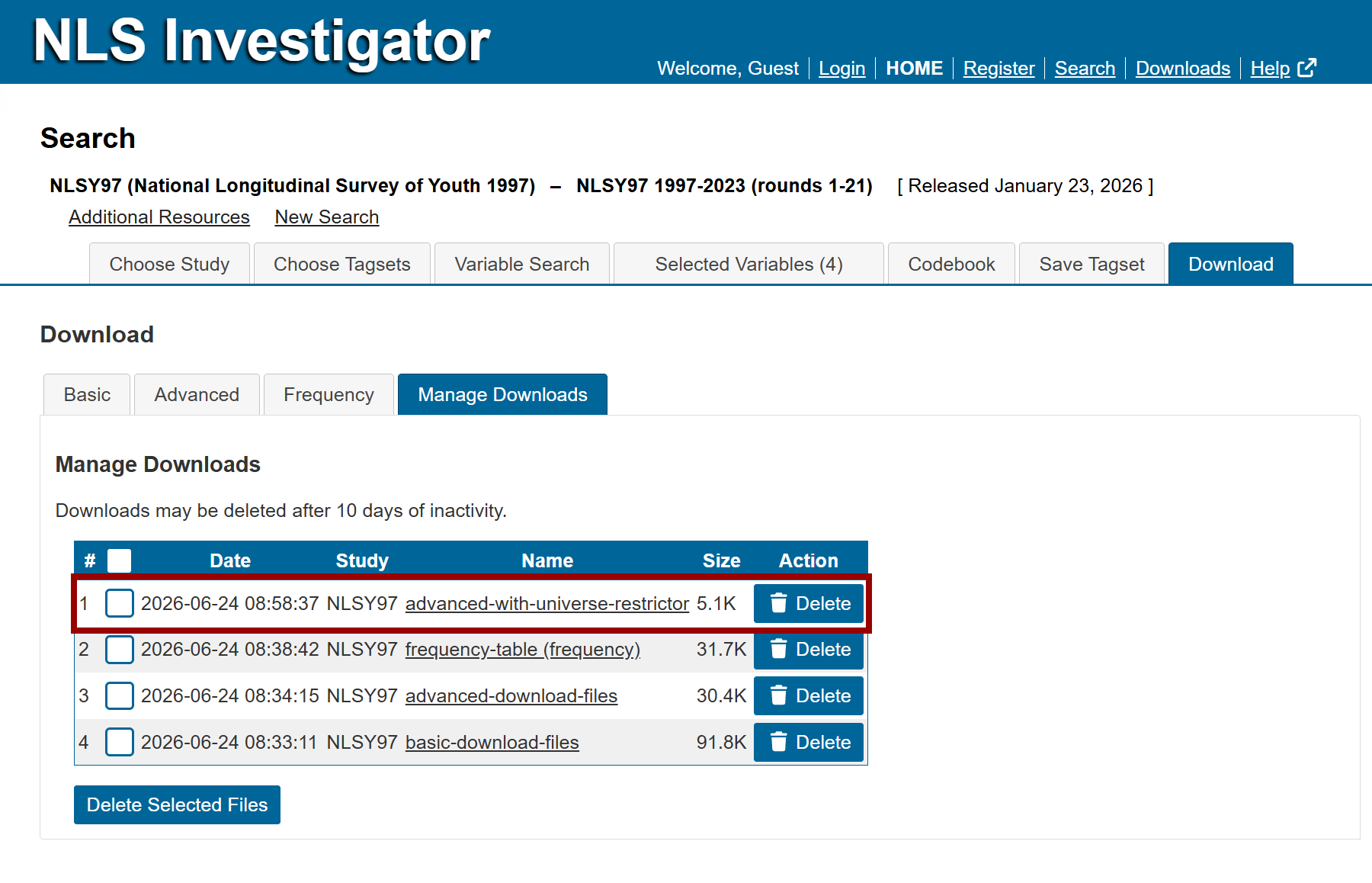
The download status will appear under the Manage Downloads sub-tab, the fourth option within the Download tab. The results will be listed in the downloads list using the filename previously entered. Click the corresponding filename link in the Name column to either download a .zip file or view a frequency table in another browser window.
Next: Frequency / Table
Previous: Customize Data Download
Quick links: Table of Contents | Glossary of NLS Terms